

Affiliate Marketing vs. Influencer Marketing vs. Brand Ambassadors: What Is the Difference?
Affiliate Marketing vs. Influencer Marketing vs. Brand Ambassadors: What Is the Difference?
If you have been researching how to grow your business through partnerships and creator collaborations, you have probably come across these three terms: affiliate marketing, influencer marketing, and brand ambassadors.
Keep in mind that sometimes, people will mix them help. But they are not the same thing. And choosing the wrong approach for where your business is right now can cost you time, money, and energy you do not have to waste.
This guide breaks down exactly what each one means, how they work, and how to figure out which one belongs in your marketing strategy.
The right approach depends on your business goals, your budget, and where you are in your growth stage. There is no universal answer.
What Is Affiliate Marketing? (Amazon’s affiliate program is everyones favoirte. )
Affiliate marketing is a performance-based partnership model. A person, usually a blogger, content creator, or website owner, promotes your product or service using a unique link or discount code. When someone makes a purchase through that link, the affiliate earns a commission.
The key thing to understand: you only pay when a sale happens. There is no upfront cost for the content itself.
Relationship type: Transactional Commitment level: Low. Most affiliate programs are open to applications and do not require a deep vetting process. Best for: Driving direct sales and tracking revenue from specific sources. Key metric:Conversions and revenue generated.
Common examples:
Blog posts with affiliate links
Coupon code partnerships
Amazon Associates style programs
Affiliate marketing works well when you have a product with a clear price point and you want a low-risk way to expand your reach without paying for content upfront.
What Is Influencer Marketing?

Alex Earl - Currently one of the biggest influencers.
Influencer marketing is when you pay a content creator to produce content that features your brand. You are not paying for sales directly. You are paying for reach, visibility, and the trust that creator has already built with their audience.
This is a campaign-based model. You identify a creator whose audience aligns with your ideal client, agree on deliverables and payment, and they create content around your brand.
Relationship type: Campaign-based. This is usually a short-term collaboration tied to a specific launch, season, or goal.
Commitment level: Medium. You are vetting creators more carefully because you are paying upfront for content.
Best for: Building brand awareness, reaching new audiences, and generating high-quality content.
Key metric: Reach, impressions, and engagement rate.
Common examples:
A sponsored Instagram post or Reel
A paid YouTube review or tutorial
A one-time TikTok feature during a product launch
One thing to keep in mind: influencer marketing gets results when there is genuine alignment between the creator and your brand. Paying for a post from someone who has never used your product and whose audience does not match your client rarely moves the needle.
What Is a Brand Ambassador?
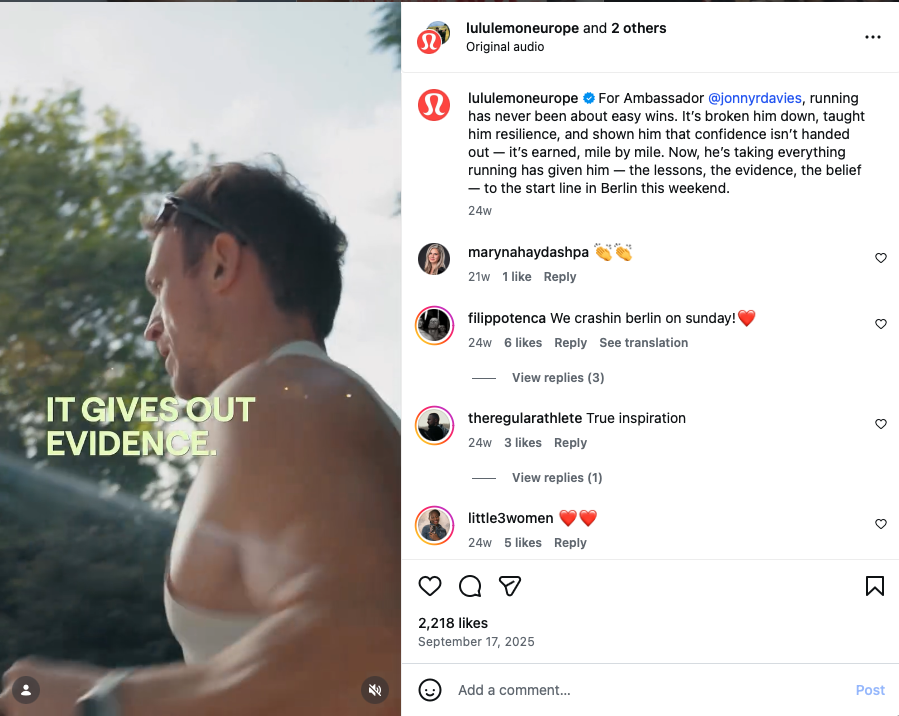
Lululemon has a great strategy on brand ambassadors.
A brand ambassador is a long-term partner who genuinely believes in your brand and represents it consistently over time. Unlike a one-time influencer campaign, an ambassador relationship is ongoing. They integrate your brand into their content, their conversations, and sometimes their in-person presence.
This model requires more investment on both sides, which is exactly why it tends to produce the deepest results. Their audience sees them use your product repeatedly. That repetition builds real trust.
Relationship type: Ongoing partnership. This is a strategic, selective collaboration.
Commitment level: High. You are looking for alignment in values, audience, and voice.
Best for: Building brand loyalty, deepening community trust, and creating a consistent brand presence.
Key metric: Brand sentiment, community growth, and customer lifetime value.
Common examples:
A monthly content creator who regularly features your products or services
An in-person event representative
A brand spokesperson who appears across multiple channels
Side-by-Side: A Quick Comparison
Affiliate Marketing: Goal is sales. Pay structure is commission. Relationship is transactional. Timeline is ongoing.
Influencer Marketing: Goal is awareness. Pay structure is a flat fee. Relationship is campaign-based. Timeline is short-term.
Brand Ambassador: Goal is loyalty. Pay structure is retainer or perks. Relationship is an ongoing partnership. Timeline is long-term.
These are not competing strategies. Many brands use all three at different stages of their growth.
So Which One Is Right for Your Business?
Honestly? It depends.
There is no one-size-fits-all answer here. The right approach comes down to your current business goals, what you can realistically invest, where you are in your growth stage, and who your audience actually is.
A product-based brand launching something new has a different need than a service-based business focused on building long-term trust. Before you decide on a path, ask yourself:
What outcome am I actually trying to achieve right now?
What can I realistically invest, both financially and in terms of time?
What kind of relationship do I want with my partners?
Where is my audience spending their time?
The answers to those questions will point you in the right direction more than any trend or tactic will.
Strategy comes before tactics. Always. Picking a partnership model without a clear goal is how businesses waste budget and lose confidence in marketing altogether.

Social Media Isn’t Slow, Your Strategy Is Seasonal
Social Media Isn’t Slow
Every year, I see the same posts.
“Engagement is down.”
“The algorithm must have changed again.”
“People just aren’t online right now.”
And every year, I remind my clients of one simple truth: social media isn’t slow, your strategy is seasonal.
Why Your Numbers Drop in November (and Why That’s Not a Bad Thing)
Before you panic about views dipping or likes slowing down, take a step back. People aren’t disappearing. They’re shifting.
In Q4, your audience’s attention moves toward holiday prep, year-end projects, and family time. That doesn’t mean they’re uninterested, it means they’re engaging differently.
Lower engagement doesn’t always signal decline. Sometimes, it means your people are busy living their lives.
The key? Adjust your content to meet them there.
Seasonal Marketing Is Strategic Marketing
Every business has seasons, and so does your audience.
Your marketing shouldn’t fight that rhythm. It should flow with it.
When engagement dips, it’s not time to chase trends. It’s time to strengthen your foundation:
Revisit your analytics and see what content is still performing steadily.
Use slower months to batch content, audit your profile, and plan for Q1.
Focus on building connection instead of forcing conversion.
This is what I call seasonal strategy: using your quieter moments to prepare for your growth moments.
The Hidden Advantage of “Slow” Seasons
When things feel quiet, it’s your opportunity to get intentional.
Brands that use this time to refine their messaging, refresh their visuals, and plan their next launches come into January miles ahead.
Think of it as your marketing off-season, the time to rebuild your systems and strategy without pressure.
Why “Always-On” Marketing Burns You Out
Let’s be honest, trying to stay viral all year is exhausting.
There’s a difference between being consistent and being constantly on.
The businesses that grow sustainably know when to pull back, observe, and realign.
They don’t chase every trend. They plan for longevity.
So if your views are down, take a breath. This is the perfect time to look at your analytics, update your strategy, and get ready for your next season of visibility.
How to Pivot Your Content This Month
Here’s what I tell my clients every November:
Create content that nurtures trust, not urgency. Behind-the-scenes posts, gratitude messages, and value-packed tips build loyalty.
Batch plan your next 30–60 days. What do you want your audience to feel when January hits? Plan that now.
Run your data. Which content still performs even when the algorithm feels “quiet”? That’s your evergreen strategy.
This is your chance to work smarter, not harder.
The Takeaway
Social media isn’t slow. It’s just shifting, and if you learn to shift with it, you’ll never fall behind.
Use this season to strengthen your systems, refine your strategy, and create space to grow intentionally next year.
Because strategy doesn’t sleep, it simply changes with the season.
Ready to Build a Seasonal Strategy That Works?
If you want to learn how to use quieter months to build consistency and growth, grab my free Social Media Gap Audit.It’ll help you see where your content strategy thrives and where it needs more support.

The Metric That Actually Predicts Your Growth Next Year
social media retention, customer retention metrics, how to measure brand loyalty, marketing strategy 2026
Everyone talks about follower count, reach, and engagement — but there’s one metric that tells me more about a brand’s future growth than any of those ever could: retention.
I talk about this a lot on social media, because retention is what separates a “busy business” from a scalable one.
What Retention Really Means
Retention measures how well your audience sticks with you — how often they return, engage again, or buy again. It’s the pulse of your brand’s health.
If engagement shows interest, retention shows trust.
If sales show results, retention shows sustainability.
When people keep showing up, commenting, or purchasing — even when you’re not running a campaign — that’s real growth.
Why It Matters More Than Any Other Metric
Because retention proves your marketing isn’t just working — it’s compounding.
It tells you that your message, content, and customer experience are aligned.
Without retention, every sale you make starts from zero.
With it, every launch gets easier.
How to Track Retention on Social Media
You don’t need fancy software — you just need consistency and awareness.
Here’s where to look:
Story Views: Are your regular viewers staying consistent?
Engagement Ratio: Are the same people commenting or saving your posts?
Email Click-Throughs: Are subscribers staying active after they join?
Customer Repeat Rate: Are they coming back for new offers or services?
Retention isn’t about vanity — it’s about depth.
How to Improve It in 2026
Focus on relationship content — stories, personal insights, and client spotlights that build loyalty.
Reward consistent followers — early access, loyalty perks, or community features.
Use your data — see what content brings people back and do more of that.
Growth next year isn’t about doing more.
It’s about doing what works — and doing it again.
Final Thought
Your retention rate is the quiet proof that your marketing is working.
Because while everyone else is chasing new followers, you’re building a business people never want to leave.

The Psychology of Connection: Why People Buy From Brands That Feel Human
why people buy from brands, emotional marketing strategy, brand trust psychology, building authentic connection
You can post consistently.
You can share all the right tips, trends, and reels.
But if people don’t feel something when they see your brand, they’ll scroll right past it.
Because the truth is, people don’t buy from perfect businesses. They buy from relatable humans.
The businesses that win aren’t the loudest; they’re the ones that make their audience feel seen, understood, and connected.
Let’s unpack the psychology behind it.
1. We Buy Based on Emotion, Not Logic
Research shows that people make buying decisions emotionally and justify them logically afterward.
That means no matter how professional or polished your brand is, people are drawn to how you make them feel first.
A clear offer might catch attention, but emotional connection builds trust.
Whether it’s through storytelling, behind-the-scenes posts, or showing up as your authentic self, your audience needs to feel something before they’ll take action.
2. Familiarity Builds Trust (Even Without Selling)
Ever wonder why your favorite brands feel almost like friends? That’s the power of familiarity.
The more often your audience sees your content, your tone, or even your face, the more trust you build. It’s called the mere exposure effect — people naturally trust what they recognize.
So even when your content isn’t selling, it’s still working. Every story, caption, or video that reminds people of who you are helps turn awareness into loyalty.
3. Authenticity Isn’t About Oversharing
Authenticity is one of the most overused words in marketing, but here’s the truth: it’s not about sharing everything. It’s about showing real alignment between your words and your actions.
Your audience doesn’t need to know every detail of your life. They just need to trust that what you say and what you deliver match up.
That kind of consistency builds credibility faster than any viral reel.
4. Your Brand Voice Is Your Connection Tool
Your visuals attract people, but your words keep them.
How you talk online — your tone, captions, and even your CTAs — shapes how people feel about you.
When your messaging feels conversational, confident, and clear, people engage more because they feel like they’re talking to a person, not a brand.
Take a look at your last few posts. Do they sound like a conversation or a pitch? That answer alone can tell you a lot about your connection strategy.
5. Connection Converts Faster Than Discounts
It’s easy to think people buy because of promotions, but most often, they buy because they believe in you.
When your audience connects emotionally, they stop comparing prices and start paying attention to value.
They’re not buying a service or a product. They’re buying the confidence that you’re the right choice.
The Takeaway
Connection is your most powerful marketing strategy.
Algorithms change, trends fade, and attention spans shrink, but genuine connection always converts.
So before you plan your next piece of content, ask yourself this:
How do I want people to feel when they interact with my brand?
Because in the end, emotion drives action, and connection drives growth.

The Truth About Black Friday: Why More Sales Don’t Always Mean More Growth
Black Friday social media tips, sustainable marketing growth, marketing strategy for small business
Black Friday is almost here, and if your feed looks anything like mine, it’s full of countdowns, flash sales, and “biggest deal of the year” graphics. But while everyone’s focused on discounts and urgency, there’s a quieter truth most business owners miss: more sales don’t always equal more growth.
I talk about this all the time on social media because chasing short-term wins can actually hurt your long-term strategy. The smartest brands don’t just sell harder during Black Friday. They use it to collect data, insights, and relationships that set them up for sustainable success.
Let’s talk about why, and what you can do differently this season.
1. Discounts Don’t Build Loyalty, Experience Does
Yes, sales bring in quick cash flow, but they don’t guarantee loyalty. A buyer who shows up only for 40% off is chasing the deal, not the brand.
What to do instead:
Make your sale feel like service. Add value through exclusive content, loyalty perks, or early access.
Use this time to nurture repeat customers. Thank them personally, invite feedback, or highlight their stories.
The sale might end in 48 hours, but the impression you leave should last months.
2. Your Conversion Rate Matters More Than Your Revenue Spike
A big sales day looks impressive, but what’s your cost per sale? Did your engagement or ad spend increase? Did your audience actually grow, or did you just sell more to the same few customers?
Real growth is when your marketing systems convert new followers into loyal buyers without relying on deeper discounts.
If your conversion rate is stable or improving, that’s the real win.
3. Data Is the Real Black Friday Goldmine
Your analytics from November tell you more than any sales number ever will.
Look at:
Which product or service pages drove the most traffic
What type of content brought people to your site
Which emails or posts had the highest click-through rate
That’s your blueprint for Q1. Black Friday isn’t just about making noise. It’s about listening to what your audience responded to.
4. Short-Term Hustle, Long-Term Strategy
If you spent the last few weeks posting nonstop just to keep up with the hype, take a deep breath. You don’t need to run your business like a 72-hour sprint.
Growth happens when you can sustain momentum long after the sale ends.
Ask yourself:
What content can I repurpose from this campaign?
What new followers can I turn into long-term leads?
How can I simplify this process next year?
The goal is consistency, not chaos.
5. The Real Metric to Watch: Retention
It’s easy to get caught up in total revenue, but retention is where true profitability lives.
If you can turn one-time Black Friday buyers into repeat clients, you’ve won.
Use automation, personalized follow-ups, or loyalty incentives to keep the relationship going.
Your post-Black-Friday strategy should be just as strong as your launch plan.
The Takeaway
Black Friday is a moment, not a measure of success.
The businesses that grow through Q4 are the ones who track what really matters: connection, conversion, and consistency.
So this season, skip the stress of trying to out-discount everyone else. Focus on learning from the data and building systems that make your next sale easier, not harder.
Ready to Turn Data into Growth?
If you’re ready to stop guessing what’s working on social media, book a Power Hour Strategy Session with me. We’ll look at your metrics, spot the gaps, and create a clear plan for sustainable growth beyond Black Friday.